
Cookieless Commerce in 2026: Why AI Product Discovery Replaces Third-Party Data
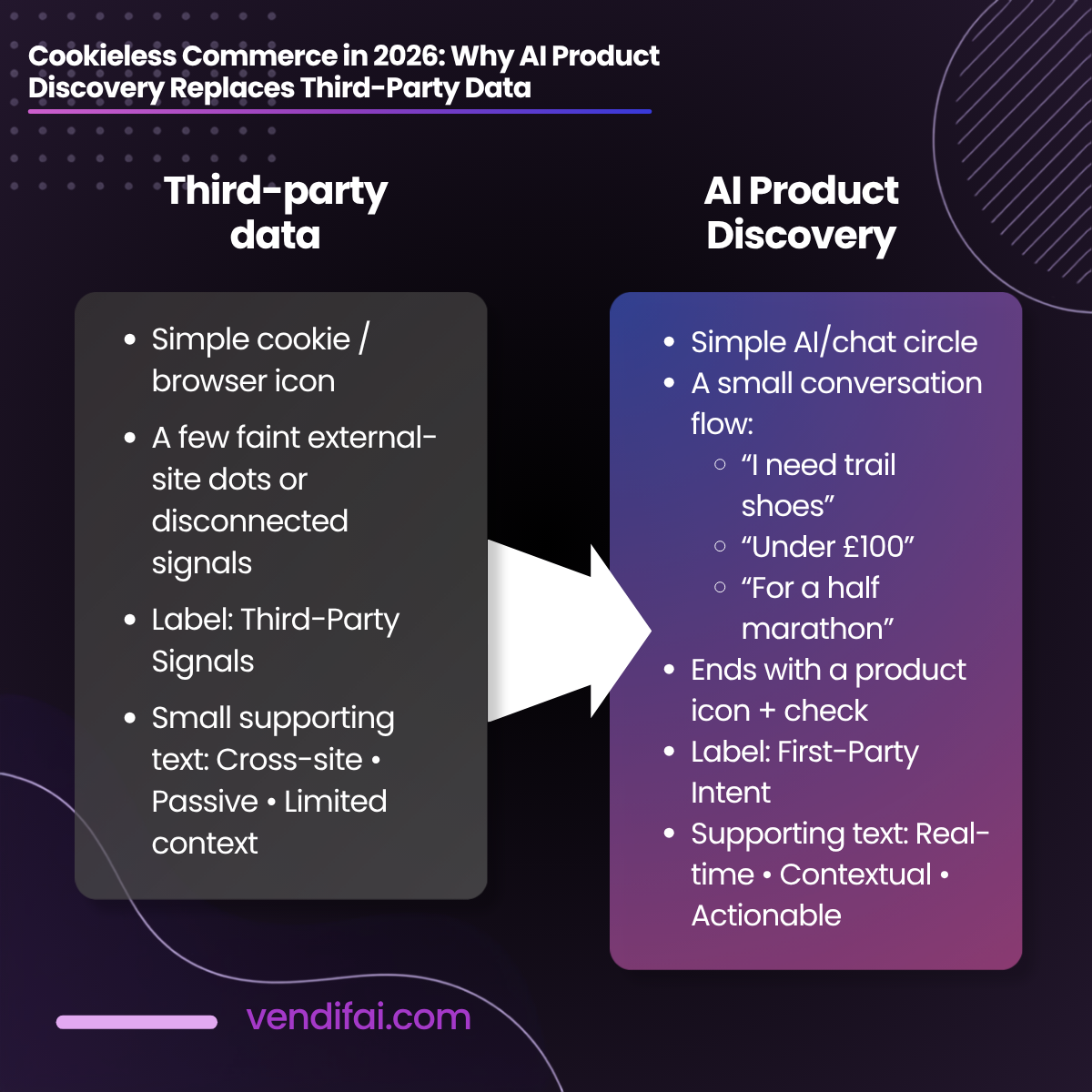
The cookieless future has arrived, not suddenly, but gradually, and now it is clear. Third-party cookies, the technology that supported a decade of retargeting, behavioral advertising, and off-site personalisation, are no longer accessible across the major browser systems. For ecommerce brands that rely on third-party data strategies, this is not an issue for the future. It is the reality of today. AI product discovery offers a more effective and sustainable option.
What disappears without third-party cookies
- Cross-site retargeting: showing ads to shoppers based on their activity on other websites
- Behavioral audience segments created from third-party data brokers
- Attribution models that tracked the customer journey across multiple domains
- Personalisation based on external browsing history that is not directly shared with your store
- Lookalike audience targeting created from third-party profile data
What AI product discovery provides instead
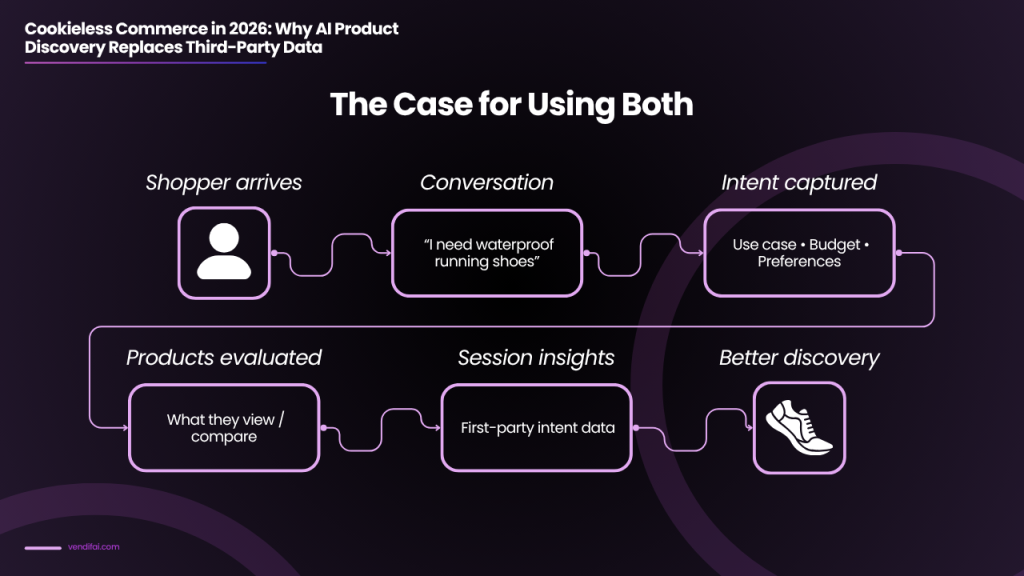
AI product discovery is inherently first-party. When a shopper interacts with Shopping assistant, the intent signals generated, what they say they need, how they respond to questions, which products they evaluate, and what they ask, first-party data collected transparently during the active shopping session.
This session-based product discovery method is not just a compliant alternative to third-party data. In many ways, it is more valuable. The signals are real-time, contextually rich, and directly relevant to the purchase decision. They are gathered with the shopper’s active input rather than passively collected from their behavior across the web.
First-party intent data: More valuable than third-party signals
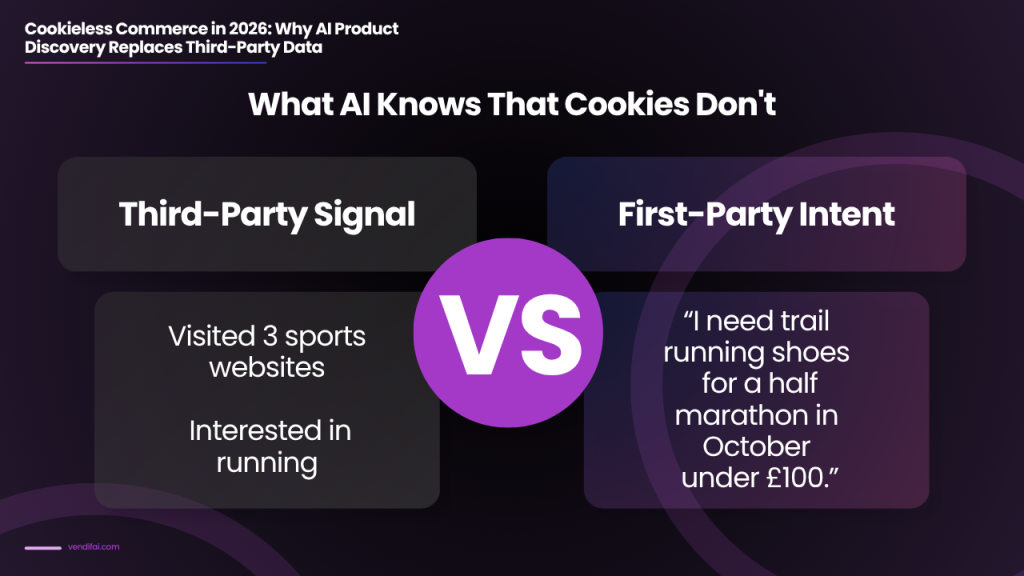
Think about the difference between knowing ‘this shopper visited three sports websites in the past week’ (third-party signal) and knowing ‘this shopper just told our Shopping Companion they need trail running shoes for a half marathon they are training for in October, with a budget under £100, and they are currently considering two specific options’ (first-party intent data).
The first signal shows you something about interest. The second reveals exactly what the shopper needs, right now, in the context of an active purchase decision. For personalization and discovery, the first-party signal from conversational AI is clearly superior.
Building a privacy-first discovery strategy
A compliant AI product discovery strategy that doesn’t use cookies does not require complicated legal or technical infrastructure. It needs the right platform.
| Data Type | Cookie-Dependent Approach | AI Discovery Alternative |
|---|---|---|
| Shopper intent | Third-party behavioural segments | Session-based conversational intent discovery | Product preferences | Cross-site browsing history | In-session follow-up questions via Shopping Companion |
| Social proof | External review aggregation | What Customers Say, structured first-party review intelligence |
| Personalisation | Third-party profile data | Real-time contextual targeting from active session signals |
| Retargeting | Third-party cookie-based audiences | On-site guided re-engagement via proactive Shopping Companion |
Why this is a competitive opportunity, not just a compliance challenge
Brands that see the cookieless transition as a compliance issue and rush to find cookie alternatives are overlooking a strategic opportunity. The brands establishing first-party intent infrastructure, through conversational discovery, session-based personalisation, and AI-powered shopping companions, are creating data assets that increase in value over time and cannot be duplicated by competitors that depend on external data suppliers.
Performance dashboard captures first-party session data from every AI interaction. Over time, this data improves product recommendations, leads to smarter follow-up questions, and creates a more effective discovery experience, all without a single third-party cookie.
Frequently asked questions (FAQs)
Cookieless commerce refers to ecommerce strategies and technologies that do not depend on third-party cookies for personalisation, targeting, or attribution. Instead, it uses first-party data, session signals, and on-site behavior.
AI product discovery generates rich first-party intent data through conversational interaction. It focuses on the shopper’s stated needs, preferences, and questions, rather than passively tracking their behavior on external websites.
Session-based product discovery uses signals gathered during an active shopping session, including queries, responses to follow-up questions, and products evaluated, rather than relying on historical or cross-site behavioral data. It is both more accurate and more privacy-compliant than cookie-dependent personalisation.