
How to measure the ROI of AI product discovery: metrics every ecommerce team needs
Investing in AI product discovery without a measurement framework is a blind investment. The technology provides real commercial results, but those results need tracking to show value, justify ongoing funding, and find areas for improvement. Here is a complete guide to measuring the ROI of AI product discovery, covering the most important metrics and the dashboard data you should review each week.
Why standard ecommerce metrics miss the impact
Most ecommerce analytics platforms track overall conversion rate, total revenue, and average order value. While these key numbers will improve with effective AI product discovery, they obscure the specific impact and make it hard to link improvements directly to the discovery process. Measuring AI product discovery ROI needs metrics that separate the discovery experience and compare it to sessions without that help.
The core metrics to track
Focus measurements on these key performance indicators:
| Metric | What It Measures | How AI Discovery Moves It |
|---|---|---|
| Zero-result rate | % of search queries returning no results | Drops significantly with semantic AI search | Search conversion rate | % of search sessions resulting in purchase | Increases as relevance improves |
| Revenue per visitor (RPV) | Revenue generated per site visit | Increases in AI-assisted vs unassisted sessions |
| Add-to-cart rate from AI sessions | % of Shopping Companion sessions adding to cart | Direct measure of guided discovery effectiveness |
| Return rate by discovery source | Returns from AI-guided vs unassisted purchases | Lower for AI-guided, more confident decisions |
| Average order value (AI vs unassisted) | Basket value with and without AI guidance | Often higher with guided discovery |
| Ask Anywhere engagement rate | % of product page visitors using Ask Anywhere | Indicates friction resolution usage |
| Search exit rate | % of users leaving after search results page | Decreases as result relevance improves |
How to set up your measurement framework
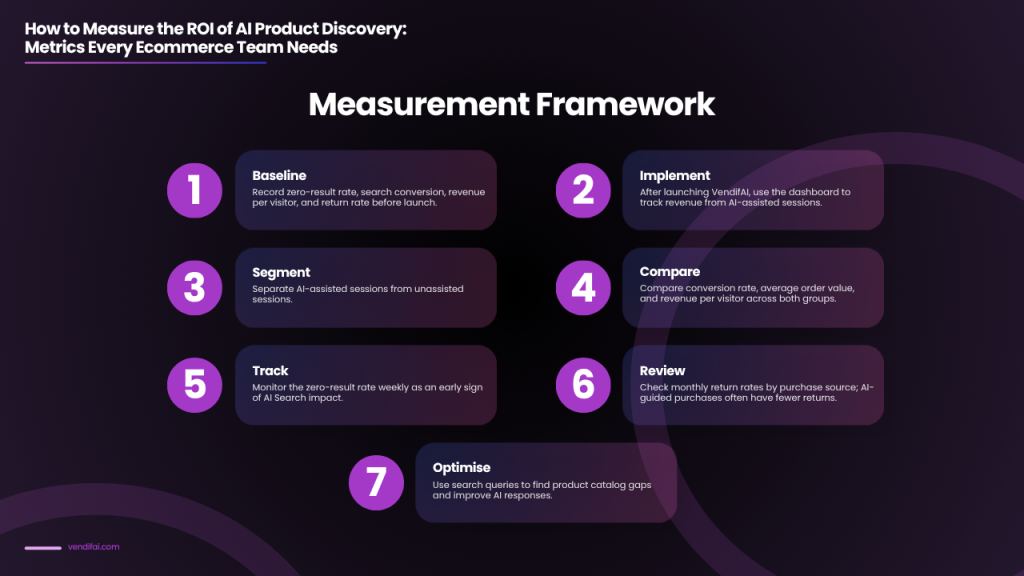
Step 1: Establish baseline metrics before implementation, including zero-result rate, search conversion rate, revenue per visitor, and return rate.
Step 2: After implementing VendifAI, access the performance dashboard for real-time revenue attribution data.
Step 3: Segment sessions into AI-assisted (Shopping Companion, Ask Anywhere, AI Search) and unassisted.
Step 4: Compare conversion rate, average order value, and revenue per visitor between the two segments.
Step 5: Track zero-result rate weekly, as this is the clearest early indicator of AI Search impact.
Step 6: Review return rates by purchase source monthly. Purchases guided by AI usually show lower return rates.
Step 7: Use search query data to identify remaining gaps in product catalog coverage or AI response quality.
VendifAI's performance dashboard
VendifAI has a performance dashboard that automates most of these measurements. Revenue attribution shows how AI-driven interactions affect sales. Conversion performance tracks which products are most often added to the cart through AI discovery. Response intelligence monitors the quality and efficiency of interactions.
For ecommerce teams that need more detailed data, the platform interaction logs can be integrated with your current analytics stack, Google Analytics, Shopify Analytics, or your preferred BI tool.
Reporting ROI to stakeholders
When sharing AI product discovery ROI with leadership or investors, highlight three metrics that directly connect to business value: revenue attributed to AI-assisted sessions (which shows direct impact), reduction in return rates (which reflects cost savings), and improvement in zero-result rate (which indicates the scale of discovery issues solved).
Combining these metrics creates a strong case: more shoppers find what they need, buying confidently, and generating fewer costly returns.
Frequently asked questions (FAQs)
Prioritize zero-result rate, search conversion rate, revenue per visitor from AI-assisted sessions, add-to-cart rate from Shopping Companion interactions, return rates by discovery source, and average order value with and without AI guidance.
Performance dashboard includes revenue attribution reporting that tracks how AI-driven interactions, AI search, Shopping Companion, and Ask Anywhere, directly affect sales. Session segmentation allows for direct comparison with unassisted browsing.
Improvements in zero-result rates can be seen within days of implementation. Changes in conversion rate and average order value typically become clear within 4-8 weeks. Improvements in return rates, which require comparing purchase groups, are usually visible within 60-90 days.