
How Does AI Product Discovery Personalise Recommendations for Each Shopper?
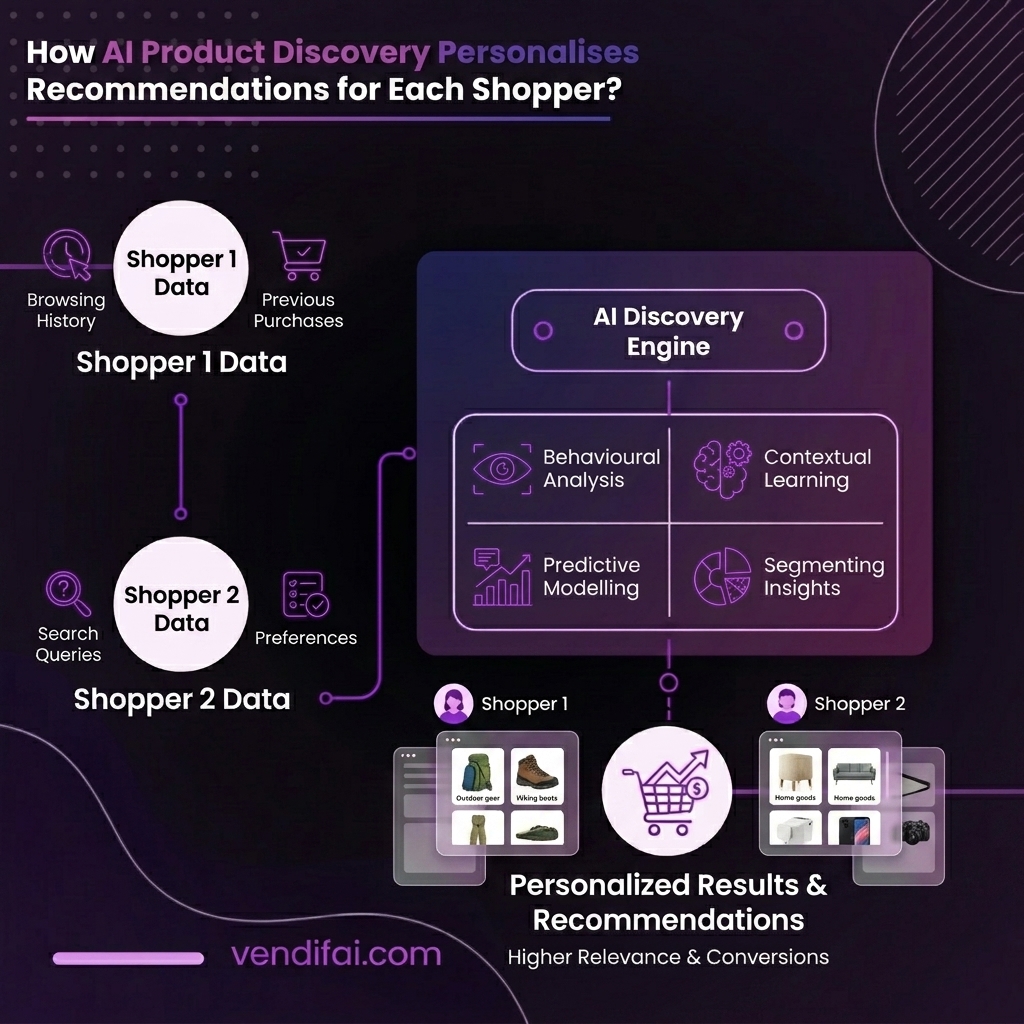
Personalisation has become a crucial aspect of modern ecommerce. Shoppers expect online stores to recognize what they want, rather than showing the same products to everyone.
AI product discovery enhances personalisation by blending product information with shopper intent and behavior signals. This helps identify products that are more relevant to individual shoppers.
How AI product discovery helps ecommerce stores
AI product discovery assists shoppers in finding products using natural language, intent, context, and product relationships. Traditional ecommerce search mostly relies on keywords, filters, categories, and set rules.
For instance, a shopper might search for:
| Attribute | Traditional Search System | AI-Powered Discovery System |
|---|---|---|
| Search Capability | Matches basic keywords (e.g., "laptop") in titles or descriptions. | Understands detailed, complex user intent and contextual requirements. | Example Input | "Laptop" | "I need a fast, lightweight laptop for video editing on the go, preferably under £900." |
| Requirements Recognized | Basic product type only | * Product type: Laptop * Activity / Intended use: Video editing on the go * Performance / Weight: Fast, lightweight * Budget: Under £900 |
| Discovery Outcome | Broad, generic product listings | Highly targeted, personalised product recommendations |
1. Understanding shopper intent
VendifAI can grasp the meaning behind a shopper’s request rather than just focusing on exact wording.
For example:
| Explicit Customer Input | Inferred Context | Target Product Feature | Practical Value |
|---|---|---|---|
| I am working at a coffee shop. | Remote / portable working environment | Long battery life | Enables multi-hour work sessions away from power outlets | Frequent travel between cafes | Durable, lightweight build | Easy to carry in a backpack without added strain or damage risk |
| (Implied creative / video workload) | Heavy rendering & export tasks | High-performance CPU/GPU | Ensures smooth video playback and fast export times |
| Visual editing & color grading | Color-accurate display | Delivers precise color representation for professional edits | |
| Large media files & multitasking | Ample RAM & fast storage | Prevents system slowdowns and speeds up file access |
This makes the discovery process feel more conversational.
2. Using product attributes
Personalisation relies heavily on quality product data. An AI system must understand the relationships between products and their attributes.
For example, a laptop catalog may include:
- Processor / CPU
- RAM & Storage capacity
- Screen size & display quality
- Battery life
- Weight & portability
- Graphics / GPU
- Price
- Use case
A shopper looking for “a lightweight touchscreen laptop for college lectures” can then be matched with various relevant attributes instead of just one keyword.
3. Understanding behavior
Depending on the e-commerce setup, AI systems can also use behavioral signals.
These may include:
- Previous searches
- Products viewed
- Products clicked
- Products added to cart
- Purchase history
- Category interactions
- Stated preferences
For instance, if a shopper often looks at premium running items, an AI shopping experience may prioritize products that fit that interest.
However, personalization should always be handled with care. The goal is to improve relevance, not overwhelm shoppers with assumptions.
4. Context changes recommendations
A shopper can have different needs at various times. Someone who typically buys running gear might search for:
“I need a gift for my team member who just started running.”
The system should recognize that the current intent is gift discovery, not personal running gear.
Context helps AI differentiate between various shopping missions.
5. Natural-language recommendations
AI product discovery can also allow shoppers to explain their needs conversationally. Instead of navigating through:
Category > Laptops > 15-inch > Processor > RAM > Price
The shopper can simply describe what they need.
For example:
“Find me a reliable 15-inch laptop for graphical artworks, under £600, in Black.”
An AI discovery system can interpret those requirements and use them to narrow down the product catalog.
6. Recommendations vs. discovery
Personalised recommendations and product discovery are related, but they are not the same.
Recommendation systems typically respond to:
“What product should I consider based on what I already know about you?”
Product discovery addresses:
“What products are relevant to what I want to achieve right now?”
Discovery is especially important when shoppers are unsure of the exact product they want.
7. Why better personalisation matters
When shoppers quickly find products that meet their needs, ecommerce businesses can reduce search friction and enhance the shopping experience.
- Better discovery helps shoppers:
- Find relevant products faster
- Explore suitable alternatives
- Understand product differences
- Discover products they might miss otherwise
- Make more confident decisions
For ecommerce teams, this can lead to stronger engagement and potentially improved conversion rates.
How VendifAI fits in?
VendifAI’s AI Product Discovery helps ecommerce businesses understand shopper intent, rather than depending solely on traditional keyword matching.
AI Search and Shopping Companion capabilities enable shoppers to interact with products in conversational language. This helps connect their needs with relevant products.
The main idea is simple: instead of making shoppers learn how your catalog is organized, let the shopping experience understand how they describe their needs.
Final thoughts
VendifAI’s AI product discovery personalises ecommerce experiences by combining shopper intent, product information, context, and behavior signals. The greatest opportunity isn’t just recommending more products; it’s helping each shopper find the right products with less effort. For large ecommerce catalogs, this change from keyword matching to intent-driven discovery can create a much more natural shopping experience.
Frequently asked questions (FAQs)
AI product discovery is shifting ecommerce from keyword-based search to conversational, intent-driven shopping. Instead of looking for individual products and applying multiple filters, shoppers will be able to describe their goals, preferences, budget, and context in natural language. AI can then understand those needs and help identify, compare, and refine relevant products.
Increasingly, yes. AI shopping assistants can interpret vague or exploratory requests and help shoppers clarify what they need. Rather than requiring customers to know the exact product, specifications, or category terms, AI can use conversational context and product connections to guide them from a broad goal to suitable products.
Future AI shopping experiences will consider the shopper’s current conversation and shopping mission along with relevant behavioral and product data. This means recommendations can change depending on whether someone is shopping for themselves, buying a gift, preparing an event, replacing an existing product, or exploring something new. Therefore, context will be as important as historical preferences.
AI is more likely to complement and improve traditional search rather than simply replace it. Keyword search, categories, and filters are still useful for shoppers who know exactly what they want. AI discovery adds a conversational layer that helps those with complex requirements, vague goals, or limited product knowledge to find relevant products more intuitively.
The future of personalization could go beyond recommending products based mainly on past behavior. AI can connect what a shopper wants to accomplish with product features, complementary products, alternatives, and trade-offs. This could create shopping experiences where AI functions less like a search box and more like an intelligent shopping companion that helps the customer make decisions.