
How pre-sales support drives results in e-commerce
Why retailer should invest in AI-driven customer support
Retailers tend to undervalue pre-sales support since it is more typically linked with B2B situations, in which businesses have lengthy sales cycles. However, this is a limited perspective. In fact, every transaction carried out through e-commerce includes an element of decision-making, and pre-sales support plays a vital role in closing the information gap so that customers can make well-informed decisions. It’s all about pre-sales support in e-commerce and shows you how to make use of it to expand your retail business. Should we get started?
How AI-Powered pre-sales support helps shoppers buy with confidence
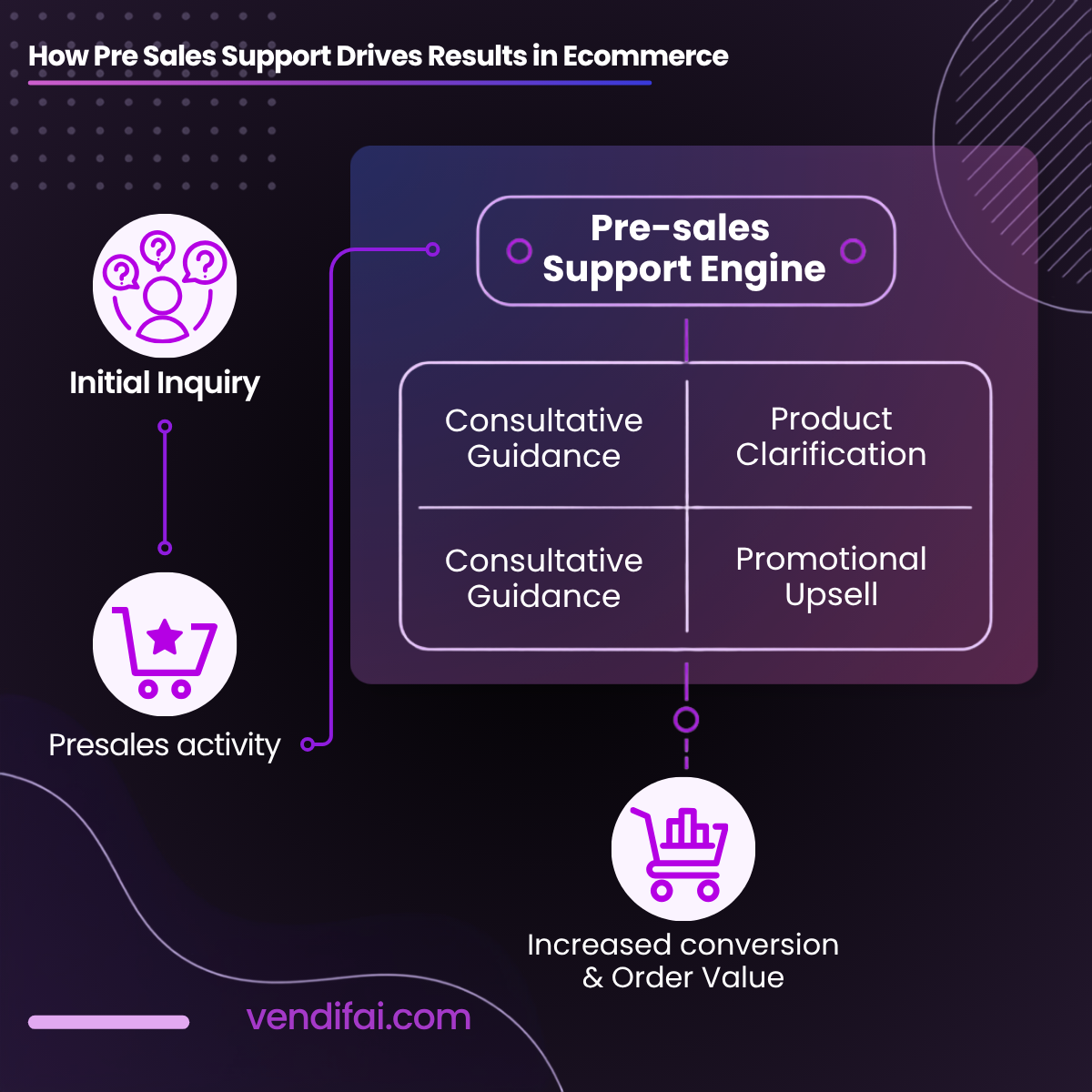
Pre-sales support includes all the actions you take to assist a customer prior to them making a purchase; it involves answering their questions, helping them to choose the correct product, and giving them the confidence needed to make their buying decisions. It might be achieved by offering a shopping companion through live chat, for example VendifAI, on your website, by having a well-written FAQ page, or by providing product comparison tools.
Why pre-sales support matters for ecommerce conversions
| Pre-Sales Challenge | What Shoppers Need | Ecommerce Impact |
|---|---|---|
| Too many product choices | Clear, personalized guidance | Reduces decision fatigue |
| Uncertainty about products | Answers questions about size, features, compatibility, etc. | Builds purchase confidence |
| Concerns about shipping or delivery | Quick and accurate information | Removes purchase hesitation |
| Similar products and prices | A helpful experience that differentiates the brand | Creates a competitive advantage |
| Lack of support before checkout | Helpful, informed assistance at the right moment | Increases conversion opportunities |
| Complex buying decisions in fashion, beauty, and electronics | Personalized recommendations and guidance | Helps shoppers choose the right product |
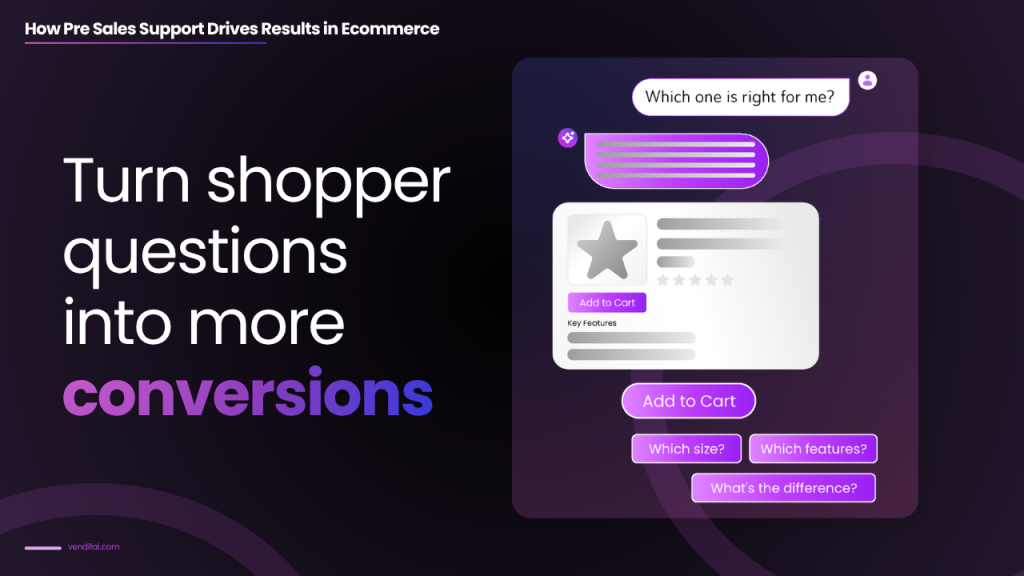
Turn shopper questions into more conversions
Just before clicking ‘Buy’, most online shoppers tend to hesitate, looking at different options, doubting the specifications, and being uncertain regarding the return policy. At that important moment, pre-sales support mostly via live chat intervenes to get rid of the hesitation. By removing any doubt, you enable action to take place.
That is why businesses which use live chat as part of their pre-sales process achieve conversion increases of up to 40 per cent (Forrester). Even more favourable is the fact that visitors who chat are almost three times more likely to buy than those who don’t (Intercom). To sum up, it’s all about being there at the right point in the customer’s journey.
Pre-sales support drives results in e-commerce
Increase order value with smarter product recommendations
Just as a smart shopping assistant does, pre-sales solutions interact with customers from the beginning by suggesting the appropriate products, not merely those the customer had searched for. It is in this context that upselling and cross-selling become effective, in a manner that seems helpful rather than aggressive.
For instance, if a person is purchasing a camera, intelligent pre-sales support could recommend a lens that is compatible or a cleaning kit according to what they inquire about.
Customers generally spend 10 to 15 per cent more per transaction if they chat before making a purchase (Invest). This is since they are not only buying but doing so with confidence and in a more thorough manner. It is akin to the ‘associate on the floor’ in a physical store, and this approach is beneficial.
Build customer trust through better shopping guidance
In e-commerce, trust is the main form of currency. If a customer contacts the company before making a purchase and receives a quick and thoughtful reply, this makes a lasting impression on them. They come to the conclusion that there is a genuine business behind the website, not just an FAQ section that frequently fails to provide proper answers. This kind of relationship builds trust, and trust leads to repeat customers.
According to Salesforce’s State of the Connected Customer report (2023), 88% of consumers claim that the experience is just as important as the product itself. “When a brand is supporting me before I decide to spend my money, I am much more likely to return.” Pre-sales support thus becomes an integral part of the brand’s voice, this voice asserting that “we’re here for you, not just your wallet”.
Reduce returns by helping shoppers choose the right product
| Return Challenge | How Pre-Sales Support Helps | Business Impact |
|---|---|---|
| Shoppers are unsure about product sizing | Answer fit and sizing questions before purchase | Reduces size-related returns |
| Product information is unclear | Provide clear, relevant product details | Helps customers make informed decisions |
| Products don't meet shopper expectations | Set accurate expectations about product features and functionality | Reduces disappointment after purchase |
| Shoppers cannot assess fit, feel, or functionality | Let customers ask questions before buying | Increases purchase confidence |
| Returns create reverse logistics and restocking costs | Help shoppers choose the right product the first time | Reduces return-related costs |
| Poor purchase experiences can reduce trust | Provide helpful guidance before checkout | Improves satisfaction and builds long-term customer loyalty |
Turn customer conversations into actionable insights
Each question a customer asks before making a purchase gives a glimpse into what is unclear, what is missing, and what is working. The contact that takes place before the sale helps obtain zero-party data, that is, insights that you do not have to work out from analytics since the customers tell you themselves.
As time goes on, this data can be used to shape product pages, help with marketing messages, optimise inventory, or even lead to the development of new SKUs. HubSpot states that 79% of customers will be willing to share relevant information if they think it will result in better service.
Real-time feedback of this kind is invaluable to agile teams since it can be used to improve product descriptions, show any gaps in your product range, or point out UX problems on your website. Therefore, pre-sales support is the way of gathering that kind of information in an organic, ethical, and effective manner.
Give shoppers AI-Powered pre-sales support with VendifAI
It’s time to think beyond basic customer service. VendifAI is more than just a support tool; it’s an AI-powered shopping companion designed to engage customers in real-time, answer their questions intelligently, and guide them towards the right purchase.
Whether you’re looking to boost conversions, cut returns, or create a standout experience, VendifAI delivers where it matters most. See how smarter pre-sales support can transform your retail business.
Frequently asked questions (FAQs)
Pre-sales support assists shoppers in making informed decisions about their purchases before they reach the checkout stage. This type of support may involve answering questions regarding products, giving suggestions, comparing different options, and dealing with any concerns they might have about sizing, delivery, compatibility, or returns.
Using AI in pre-sales support allows shopper questions to be answered instantly, decreases the friction involved in deciding, and directs customers to appropriate products. This in turn makes shoppers more confident and can cause an interest in a product to result in a purchase.
Yes, by enabling shoppers to understand the features, sizing, compatibility, and functionality of products before they buy, pre-sales support can help them to select items that better suit their needs and reduce the number of avoidable returns.
On the basis of a shopper’s needs and questions, AI is able to suggest products that are relevant and either complementary or upgraded. For instance, a person who is buying a camera might be given recommendations for compatible lenses or accessories.
VendifAI offers product discovery and shopping assistance based on artificial intelligence by engaging with shoppers in real time; it is able to answer questions, understand the intention of the shopper, recommend products that are relevant and lead customers to make confident purchase decisions.